Off the flat rectangle
Most display decisions collapse into a single question: flat rectangle, what size? The formats covered here exist because some spaces, some stories, and some audiences demand a shape that a standard panel cannot provide. This reference is for the people who have to decide whether that demand is real.
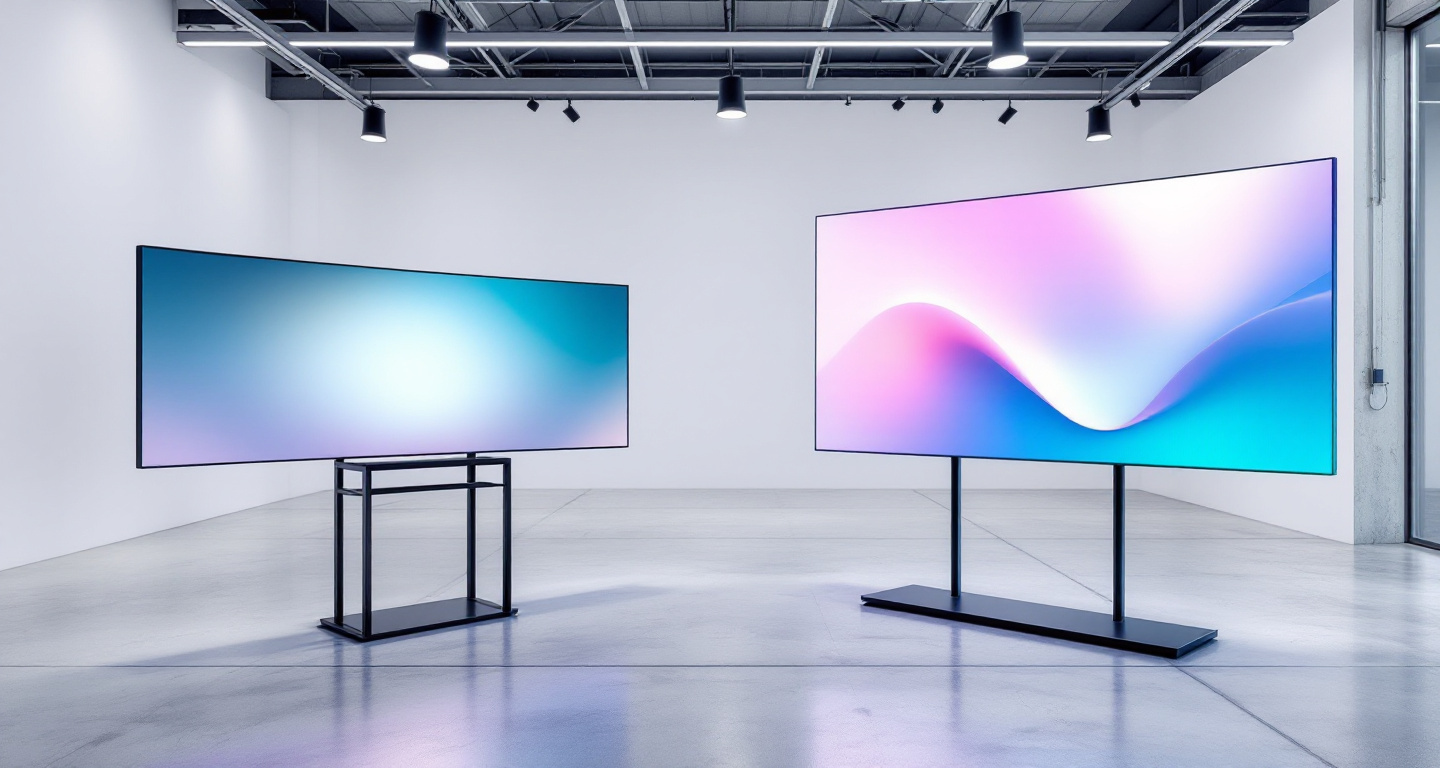
Shape is a design decision before it is a specification
A display's physical form factor does real communicative work before any content starts playing. Walk into a room with a concave curved wall of screens and your body already knows something about scale and immersion that no flat panel can convey at the same distance. That sensation — or its absence — is a direct consequence of geometry, sightline angle, and the relationship between the screen's curvature and the viewer's likely standing position. These are design variables, not incidental hardware choices.
The discipline that treats physical configuration as meaning-bearing rather than merely functional has a long history across architecture, industrial design, and theatrical staging. What is sometimes called form factor in product and systems design carries exactly this idea: the shape of a thing communicates intent, constrains use, and shapes the experience before a single feature is engaged. Display installations are no different. A tall narrow portrait panel in a corridor reads as directional signage to a passing glance. A transparent pane in a showcase invites close inspection. A countertop unit angled at seated eye level implies intimacy and interaction. The rectangle you choose, or choose to abandon, is already telling a story.
Dwell time is the practical lens through which to evaluate these choices. A viewer who spends four seconds passing a panel has different perceptual needs than one who stands for ninety seconds examining a product behind showcase glass. Sightlines and viewing distance determine whether a curved surface reads as a coherent image or as a distorted edge. Getting this analysis right before specifying hardware is less expensive than correcting it afterward.
The format families, briefly
Curved panels — both gentle single-axis bends and tighter cylindrical forms — reduce the angular distortion experienced by viewers seated or standing off-center, making them well-suited to wide presentation stages and control room environments where sightlines vary across a group. Transparent showcase glass serves retail and museum contexts where the digital layer must coexist with a physical object rather than replace it, preserving the visual relationship between product and buyer. Immersive rooms, whether LED-volume environments or projection-mapped enclosures, are purpose-built for spatial storytelling where the intent is to surround and suspend disbelief rather than present information at arm's length.
Compact countertop units occupy the opposite end of the scale: small, close, often interactive, designed for a single user in a defined position rather than a crowd. Their job is to deliver detail and prompt a decision. Architectural surfaces — screens integrated into floors, ceilings, columns, or custom-shaped building elements — earn their complexity when the installation must disappear into the fabric of a space rather than announce itself as a screen. Each of these families has a specific task it does better than a flat rectangle. None of them does everything a flat rectangle does at the same cost.
Confronting the premium honestly
Nonstandard hardware costs more at every stage of the project lifecycle. The purchase price of a specialty panel is typically higher than a commodity flat display of equivalent screen area, and that gap tends to widen as panel size or curvature increases. Mounting hardware must be fabricated or sourced from a shorter supply chain. When a panel fails after installation, replacement parts may be constrained by a single manufacturer's production schedule rather than a competitive market.
Content production compounds the cost. A curved video wall with an unusual aspect ratio requires assets designed and tested for that surface. A transparent showcase demands careful attention to contrast, color temperature, and background conditions that simply do not apply to an opaque display. The additional production overhead is not a one-time cost; it recurs with every campaign, every refresh, every update. Integrators and designers who build these numbers into project proposals before the client falls in love with the hardware are doing their clients a practical service.
The discipline this requires is the willingness to ask plainly whether a flat rectangle would accomplish the same communicative goal. If it would, the premium format is an aesthetic preference being funded as a functional requirement. That is not always wrong — there are contexts where the aesthetic is the requirement — but it should be a deliberate choice, not an unexamined one.
What happens after the installation opens
Specialty installations age differently than standard ones. A curved LED array that looked striking at launch may require calibration maintenance that a flat direct-view panel would not, and the technicians qualified to perform that work are less widely available. Transparent panels are sensitive to ambient light conditions that can change as surrounding retail fixtures are rearranged over the life of a lease. Immersive rooms built around a specific projection throw distance become difficult to reconfigure if the space is repurposed.
Spare parts availability is a legitimate operational concern, not a procurement detail to defer. Panels from limited production runs may not be replaceable with an identical unit three years after installation. A gap in a tiled surface, or a color-shifted panel that cannot be matched, turns a designed installation into a visible maintenance problem. The operating realities of any nonstandard format should be evaluated against the expected service life of the installation before the specification is final.
The formats documented in these pages are genuinely useful tools for the right problems. Understanding their operating costs as clearly as their visual possibilities is what separates an installation that earns its budget from one that impresses briefly and burdens indefinitely.
The format files
- Curved displays: when bending the screen actually helps
Curvature radius, single-viewer geometry, where curves help and hurt, mounting depth, and content review for the arc.
- Transparent displays and lightbox showcases: putting pixels in front of products
Transparent LCD vs OLED, the lighting equation, content that reads on glass, showcase builds, and when a printed lightbox wins.
- Immersive rooms: surrounding the visitor instead of facing them
Projection vs direct-view LED, floors, throughput and reset cycles, and why content refresh — not the room — is the real budget line.
- Compact and countertop formats: the small screens that do the most work
Tablet-descended stations vs purpose-built small kiosks, counter-native jobs, theft and cleaning realities, and fleet discipline.
- Screens in the architecture: door displays, smart glass, and embedded surfaces
Displays built into doors, partitions, and millwork — hinge power, slam shock, smart glass confusion, code lines, and replacement paths.
- Photo booths and experiential photo installations
Lighting, footprint, throughput at live events, durability, and the capture-to-share pipeline behind experiential photo formats.